Stirling in a Day
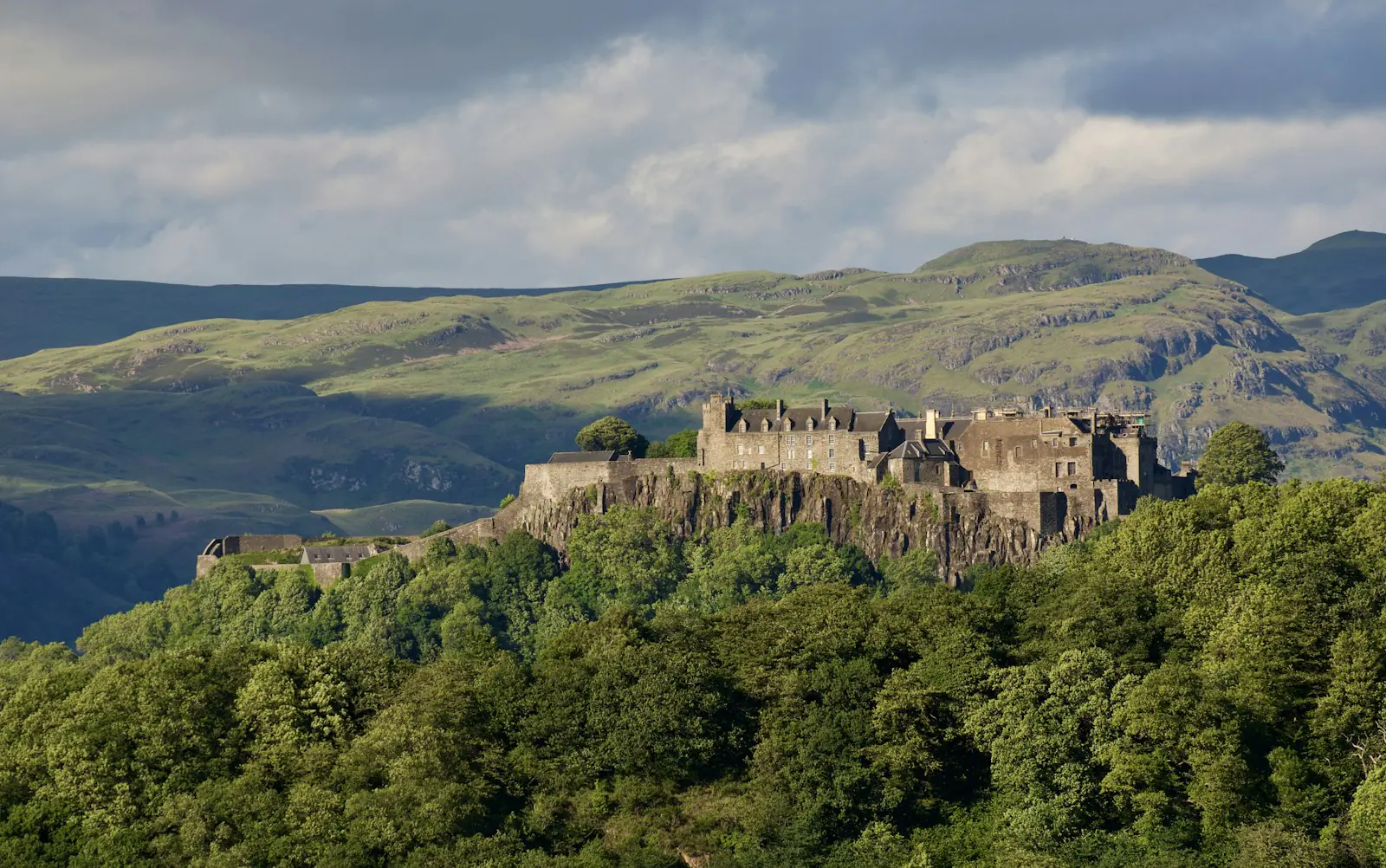
Scotland’s history concentrates on one volcanic crag: the castle that held the kingdom’s crossing, with Wallace’s tower on the next hill and Bannockburn’s field below. Edinburgh is 50 minutes away.
The short version
- Trains run Edinburgh to Stirling in about 50 minutes, several per hour at modest fares; times at scotrail.co.uk.
- Stirling Castle — royal seat of the Stuarts, siege prize of every Scottish war — sits above the town with the Great Hall restored to its ochre swagger; tickets at stirlingcastle.scot.
- The palace interiors carry the recreated Stirling Heads and unicorn tapestries; costumed interpreters run the court with straight faces and good history.
- The National Wallace Monument stands on Abbey Craig across the valley — 246 spiral steps past Wallace’s sword to a crown-top view of the Ochils and the links of Forth.
- Bannockburn’s visitor centre and field, a short bus south, cover 1314 with a 3D battle room for those wanting the third act.
- Stirling’s Old Town descends from the castle in one coherent sweep — the Church of the Holy Rude (a royal coronation site with its roof timbers intact), the Old Town Jail, and the walls walk.

Getting there
Trains from Waverley and Haymarket reach Stirling in under an hour with no planning required. From the station, the Old Town climbs directly — fifteen minutes up to the castle esplanade, steep enough to count as the day’s first exercise. Buses from the station cover the Wallace Monument (a couple of miles northeast) and Bannockburn (south); taxis are cheap and the triangle between the three sites is a transport puzzle best solved by not walking it.
The day
Castle first at opening: the Great Hall, the palace’s recreated royal apartments, the kitchens’ below-stairs theater, and the ramparts’ explanation of why every army needed this rock — the Forth crossing below was Scotland’s front door. Two to three hours honors it. Descend through the Old Town for lunch, then bus to the Wallace Monument for the spiral climb and the view that puts the castle in its strategic sentence. Bannockburn fits after for the committed, or the Church of the Holy Rude and the jail fill the town version. The evening train home needs no booking.
When to go
April to October carries the full program — interpreters, long hours, the monument’s crag in leaf. Summer brings coach waves to the castle from late morning, which the alarm’s opening-time rule dodges cleanly. Winter shortens hours and empties the esplanade; the castle in low sun over a frosted valley is the photograph the postcards can’t sell you. Hogmanay and Easter spike everything Scottish; midweek any month runs calm.
Frequently Asked Questions
Stirling or a second Edinburgh castle day?
Stirling’s castle outranks Edinburgh’s for interiors and story density, at half the crowd — locals say so quietly. As a history day it’s the stronger ticket; Edinburgh keeps the skyline.
Is the Wallace Monument worth the steps?
The 246 steps are real and the crown-top view is the region’s best — plus Wallace’s actual 1.6-meter sword en route. Skip it only for knees’ sake; the shuttle from the visitor centre handles the crag’s base climb.
What’s the Braveheart accuracy situation?
The film relocated the Battle of Stirling Bridge away from its bridge, among other liberties — the monument’s exhibits enjoy correcting it. The real story needs no soundtrack.
Castle, monument, and Bannockburn in one day?
Doable with the bus links and an early start — castle morning, monument early afternoon, Bannockburn’s centre before closing. Two of the three makes the relaxed version; the castle is non-negotiable.
Anything to eat worth planning?
The Old Town’s cafés and the Portcullis by the castle gate handle it well enough; Stirling is a history town, not a food town, and pretending otherwise wastes your appetite. Save the serious dinner for Edinburgh.